The information provided is not intended to be a substitute for professional medical advice, diagnosis or treatment. See the full disclaimer.
I am part of affiliate program(s), and may receive a small commission from purchases you make through my links, at no additional cost to you.
It’s a great way to support me, so thank you! See the full disclosure.
Today I wanted to talk about chronic migraines and watercolor, and how it’s just so cool I can watercolor while I’m feeling bad from a migraine, and like sitting in bed.
My second day ever of painting, I ended up in bed with a migraine. I had just started painting and I took the paint supplies and sat in bed and painted with a migraine.
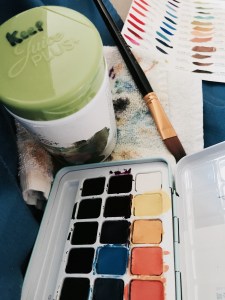
The light was really dim in my room, but I was able to paint. I wasn’t watching a tutorial, you know, I wasn’t getting any screen time in. I was just painting. I didn’t have the ability for a little while there at the beginning to watch a tutorial or find out what I should be doing and shouldn’t be doing.
I just had to put the paint on the paper.
That’s really good for you in the beginning. It helps you to figure it out for yourself.
So I made a list of stuff. I’m going to make this short. So if you’re reading this with a headache, which I definitely don’t do that too, you can read it real quick and then go paint, or bookmark it for later:
- Value studies. Anything with color might be hard to see right now, but you can tell light and dark in a dimly lit room.
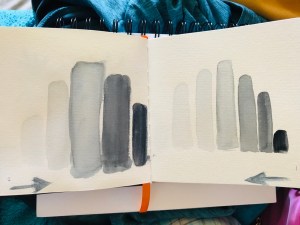
- You can do monochromatic painting or you can do an actual value study. What is the lightest version you can paint with this one paint color that you have? And then what is the darkest version you can get to? So you begin adding a little bit of paint on your brush and then painting a square and then add a little more paint to your brush and then paint another square until you get like really thick paint in a square. And then you can reverse the process and add a little water and paint lighter and add a little water and paint lighter.
- I remember finding value studies really hard when I was first beginning. If you don’t have wrist strength issues like I do, you could sketch something to paint in later, maybe with a black sharpie so you could see it.
- You can also practice brush strokes and hand movements. Even if you can’t see your paper very well, you can still practice putting the paint on the paper, like paint a whole bunch of squares, paint a line, try painting leaves or something like curves of your brush. You can practice painting not for what it looks like on the paper, but for how your wrist is being held in proportion to the paper and the paint on the paper. So that if you have wrist strength issues, you will know like I can hold my wrist like this and make a line, but this doesn’t feel as good.

- Because when you’re actually painting something like you’re following a tutorial or you have this idea in your head and you’re trying to paint a specific thing, you’re focused more on what the thing looks like than on how your wrist is being held and whether you’re holding your back, you know, in a weird angle or you’re sitting up straight or you’re getting good deep breaths, you’re painting from your shoulder, are you hurting yourself? Like if you’re busy painting, if you’re focused on what’s being painted, then you’re not paying attention to what your wrist needs. So if you have a migraine, you can’t see your paper very well anyway. This is a really good time to be like, okay, if I hold my wrist like this, it hurts. But if I hold it like this, then it feels better. Try painting, you know, away from yourself. Try painting towards yourself. I found helps to just not move your wrist at all.
- The other thing you could do is paint without being able to see it. It’s like that thing where you’re supposed to look at an object, not at your paper, and then sketch it. That’s supposed to be really good for getting the proportions right and learning how to actually draw what you’re seeing. But you can take that same principle and close your eyes and paint on your paper and not be able to see it. Just make sure that you aren’t going to be getting paint anywhere that you didn’t intend to be going.
So I don’t know where the footage went. I had a migraine, but like a year ago, I had such a bad migraine that after about two weeks, I was feeling just a little better and I was desperate to put paint on paper. And I was wearing a blindfold, what is it, a sleep mask. I was wearing a sleep mask.
This is my favorite sleepmask.
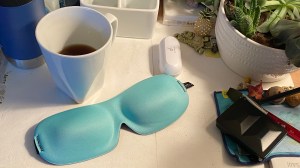
You can actually blink inside it. It’s really cool.
And I was trying to paint with the sleep mask on because my head hurt too bad to actually have any light whatsoever around me. And so I literally painted with the sleep mask on, like I was blindfolded painting. And I thought that was the coolest thing ever.
And I was sure the desk was going to get covered in paint, but no. I actually painted something I really liked. It looked cool and abstract.
Where did I put that footage? I have no idea. I had a migraine. I don’t know where it went. I lost it. It’s somewhere. Eventually, I will show it to you when I can find it, but I’ve looked. I can’t find it.
You can paint without being able to see the paper, and then you can just pull the blindfold off for a little bit and be like, oh wow, that looks really cool, next piece of paper.
Use the technique of having two books and paint on two facing pages and then grab another one and paint on two facing pages and then while this one’s drying, you go back to the first book and paint on the next two facing pages.
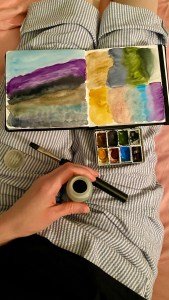
Another thing you could do is brainstorm some ideas and make lists of things to practice so you can sit there and think about painting if you can’t actually paint. Like, okay, I know I’m really bad at rivers. I should maybe practice rivers. How would I go about practicing rivers? Well, I know that rivers are supposed to be horizontal, not vertical, and all of my rivers turn out looking vertical, so I guess I could try painting that way and then make like a note that you want to practice that. And then be like, okay, we need to research perspective on rivers later when we don’t have a migraine, and we need to research maybe photographs of rivers in general. Like, you can begin brainstorming: this is a thing that I know that I need to work on.
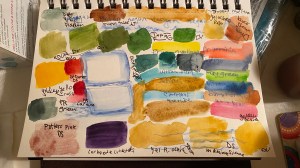
Or if you have all of your paint colors in your head like I do, you could just make color palettes. Okay, when my head’s feeling better, I’m going to paint with red iron oxide, which is also known as an Indian red or like an English red. I really like the English red from Rosa. Okay, and then I’ll put yellow ochre or raw sienna. Raw sienna is browner though, so I kind of want more of a yellow. I’ll do yellow ochre and then put that with indigo. Might look really pretty, but if I switch the indigo out for cerulean hue, cinerious or something, then the whole thing’s going to get to be a much brighter color palette.
Okay, what if I go back to the indigo and now I’ve got English red, yellow ochre, and indigo, and then switch that out for like a bright Indian yellow. That’s going to create a much different color palette. I don’t think I’m going to like the Indian yellow with the English red. I don’t think those look good together, but I could put a pink that would completely change this entire color palette.
If I used a quin pink, like a quinacridone pink, and then an Indian yellow, those would be really pretty together and I could get some warm like reddish colors if I mixed those.
And then I just started brainstorming color palettes.
You can also move paints around (using metal tins, and magnets on the backs of the pans). If you have a headache, you can take all of your little tins and all of the paints and spread everything out all over your bed and like move paints around and just in your head go, okay, well, I know those colors are going to look good together. Well, I don’t think those colors are going to look good together.
Oh, I might want to try this color with that color. How about this color and that color? Okay, now I have eight colors in this tin. No, I need 10. Okay, which tin holds 10 colors? And then just move everything around again and move it around again. I end up with a few different color palettes after this to go paint with.

And the most interesting thing is when I get in my head that I’m going to make a big color palette because those are really fun. It’s like 24 colors and then I don’t paint with it because 24 is too many. But it was fun to make the color palette. That’s something you could do.
You could also look back at your old work. So if you have like a book or a file of like all of those pages that you painted on or something, you can just flip through them. You might get ideas and go back to the brainstorming thing.
You might get some ideas of, oh actually I haven’t painted mountains like this in forever, and I wanted to do that again. Or like the mountain watercolor pattern that I did a video on a little while ago. I randomly came up with this idea. Well, I thought I kind of wanted to do that one in another color scheme or something. And that would be kind of fun. What color scheme would I use? It goes back to color again.
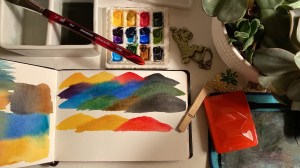
But looking back at your old work can be really fun. It’s also quite inspiring to be like, wow, look how far I’ve come.
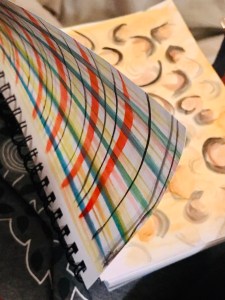
Oh, I also wrote down that you could read a book. So it depends on your headache. If you’re currently light sensitive, you could listen to a book. If you’re currently sound sensitive, then you could read a book. Although I don’t end up reading a book with a headache as much as I think I’m going to. But you could also like flip through a picture… What are they called? The tutorial books. What’s the word for this? Learning books. Where it’s like do this thing and then paint this that way. And then you can try to paint your own version of that. You know what I mean?
And then my last note: paint with a Triad, meaning three colors.
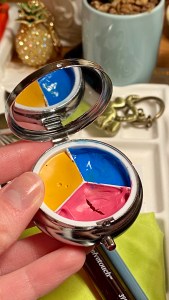
Usually it’s like a red, yellow, and a blue, but you could also switch the blue out for a green, or you could switch the red out for a green, then you just have the two colors that make green, along with a green for a triad.
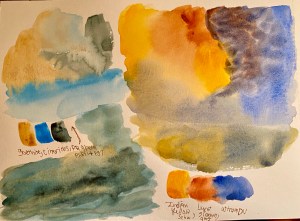
If you paint with three colors: a red, yellow, and blue, then generally everything’s going to go together because it’s all made from the same three colors. This is both true and not true depending on which three colors you pick, but anyway.
Make sure you’re getting plenty of water, eating regularly.
I’ve found Migraine Buddy app to be particularly helpful for tracking headaches. Currently, it’s not loading as quickly as I would like, so I’m a little annoyed with it, but yeah, it’s a really good app.
And then the sleep mask that I have, that’s also been really helpful.
Hopefully this was all really helpful. I definitely did not make notes on this while I had a headache, so hopefully it made sense.
~Megan 🙂
If you liked this, you might like Things That Help with Migraines.

 Megan Eileen