The information provided is not intended to be a substitute for professional medical advice, diagnosis or treatment. See the full disclaimer.
I am part of affiliate program(s), and may receive a small commission from purchases you make through my links, at no additional cost to you.
It’s a great way to support me, so thank you! See the full disclosure.
Want the YouTube Video Version?
There are Two Main Types of Migraines I have Tips for:
Light Sensitive and Sound Sensitive.
Before we start just know that the brightness of a phone, a TV, or a computer screen can trigger or make a headache worse. Here are some settings that you can change on your phone, computer, or iPad to make it easier to look at. On a TV, dig around in the settings to turn down the brightness a bit and warm up the screen to make it easier on your head.
These settings apply to all of my devices, all of the time, so I don’t trigger a headache.

with the Night Shift on and the White Point reduced
Go to the Settings app on your iPhone, iPad, or Mac.
If you’re on Android it’s called “Night Mode”.
Search in the Settings app for “Night Shift” and turn it on and up to about the letter “m”.
Then go back and repeat the same process and search for “Reduce White Point” and turn it down to 60 to 70 percent.
Also, turn on the “True Tone.” That’s really helped too. You may not find True Tone if you’re using an older Apple device.
Dark Mode may also help once the White Point is reduced so there’s not high contrast.
I’ve also found it helps to turn off “Auto Brightness” so I can control how bright my device gets myself.
I haven’t found Reduce White Point on the Mac, but you can do Night Shift depending on the age of your device and how upgraded it is.
If you’re on a Windows or a Chromebook you can download Flux to do the same thing as Night Shift on your computer.
On an Android phone, go to Settings, then Display, and turn on “Night Mode.”
Help article on night mode: https://www.samsung.com/us/support/answer/ANS00082645/
Help article on night shift: https://support.apple.com/en-us/HT207570
True tone and reduce white point: https://appletoolbox.com/steps-to-reduce-eye-strain-from-your-iphone-or-ipad/
You may not find True Tone if you’re using an older Apple device.
Flux is like night shift for computers: https://justgetflux.com

Now I’m not going to cover the medicines that you can take. I do know the sooner you take action on a headache the better off you will be. Catching it earlier helps.
I’m not a Doctor and you should follow your Doctor’s advice about this, and consider getting a Neurologist if you have frequent migraines.
This is just my experience and what helps me.
Sound Sensitivity
In addition to good sound-blocking headphones, I like to do something to distract from my head hurting.
Depends on how bad it is, if it comes in between meals, I’ll just sit and do nothing and think while I wait for the next meal. Then I can have medicine for migraines that has to be had with food. This time I was thinking through what helps with sound-sensitive migraines so I can write down for this.
It helps to start with stopping triggers, get away from loud sounds, or any sounds, and maybe find a dark room or put on sunglasses.
Then calculate your solutions to a migraine: like which medicine am I going to take, have I had food or water recently, what caused this, how do I avoid it next time, is it storming out, or was my sleep schedule way off.
After you have stabilized the situation, look for things to do. You can paint sitting in bed with travel paint supplies, which is something I did my first week painting with a migraine.
The main difference between a migraine and a headache is headache makes your head hurt, and a migraine makes you non-functional, and usually comes with light or sound sensitivity causing nausea, or maybe visual disturbances.
You can also turn on the Night Shift and reduce the White Point of your device, and half-watch something that doesn’t need audio to explain it or use closed captions.
I think most movies have closed captions, so you could watch something with barely any volume and still see what’s being said. Though it’s probably too hard to read closed captions with a migraine. Maybe watch a movie you know really well, or a YouTube video really quietly, or someone painting something. Or you could read a book but again I don’t end up reading with a migraine like I think I’m going to.
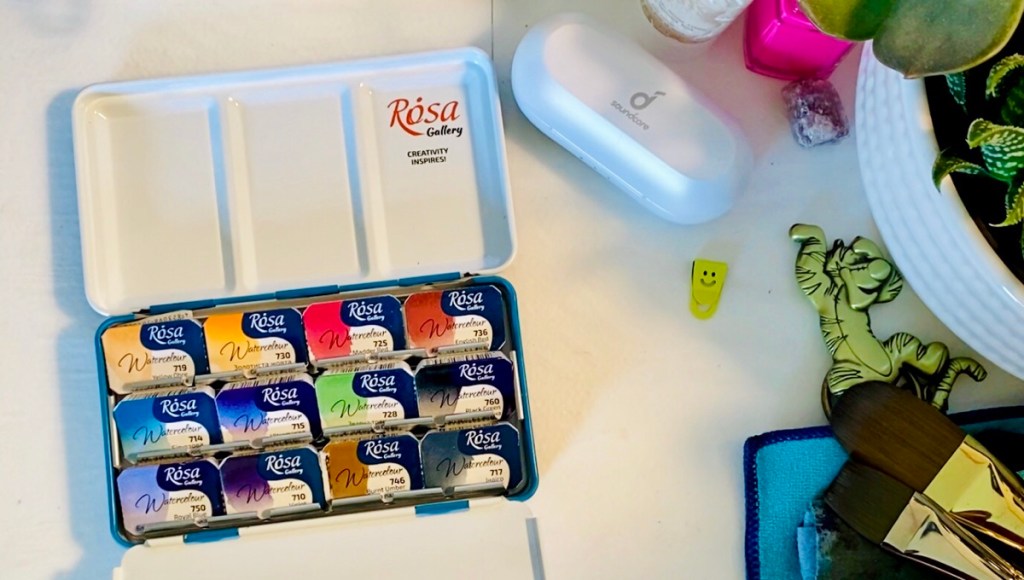
on my desk next to my Rosa watercolors
I use the Soundcore Liberty Neo wireless headphones and have found the bass on them isn’t bad. That’s probably a flaw to some people but to me who gets headaches from too much bass it’s a good thing. They’ve got good battery life and audio quality. My videos often sound better through them than out loud on the iPad speaker.
It also helps that they’re not completely noise canceling earbuds so I can still hear a little bit of what’s going on around me. It’s the equivalent of sleep mask versus sunglasses.
Soundcore Liberty Neo Earbuds: https://amzn.to/45LmlXP
Kindle Paperwhite (newer version, mine is like 10 years old): https://amzn.to/3PGgnBL

Light Sensitivity
Sunglasses help.
Sunglasses: https://amzn.to/46crojH
Warm colored computer glasses: https://amzn.to/3PoRnOk
40 Blinks Sleepmasks: https://amzn.to/48cIpfL
You can again, reduce the “White Point” and turn up the “Night Shift” on your device and then watch a movie with Audio Descriptions.
Netflix and Amazon have some movies that have Audio Descriptions for people who can’t see and want to watch movies. There’s a specific section where you can look through movies with Audio Descriptions.
It’s just like what it sounds like. They’ll describe to you what’s going on without you having to look at the screen.
How-To Audio Descriptions
Amazon: https://amzn.to/46g7Z1g
Netflix: https://help.netflix.com/en/node/25079
Amazon movies and tv shows with Audio Descriptions: https://amzn.to/3t2vHQk
Netflix movies and tv shows with Audio Descriptions: https://netflix.com/browse/audio-description
In this case, it helps to have a list of movies or TV shows ready in advance. you can make a list of YouTube videos that you don’t have to watch to know what’s going on.
Podcasts also fit into this category though I find they don’t hold my attention very well when I’m feeling bad.
You can also listen to audiobooks. LibriVox is good for that; you can listen to library books for free. If you bought a book on Kindle you can sometimes get a discount on the audio version, since you’ve already bought the book version.
LibriVox is the place with free library audiobooks:
https://librivox.org
Soundcore Liberty Neo Earbuds: https://amzn.to/45LmlXP
Sunglasses: https://amzn.to/46crojH
You could also listen to music. Just go into the settings of your music app and turn down the bass under the Equalizer first. If it’s not there, you might find it under your device’s main settings, depending on your device.
You can get a free trial of YouTube music, or Spotify or something if you don’t want to listen to the loud ads. YouTube Premium with the ad-free videos has YouTube music.
And again you could also do something like painting, even if you end up in a dark room; just a little light will do.
It’s always interesting to see your artwork in the daylight after that; it’s like oh, that was green, not blue.
You can also draw with Sharpie on watercolor paper to paint in later since Sharpie is dark enough to see.
You can also do value studies using just one color and then trying to get different light and dark versions of it; that’s a great way to learn water control.
Bonus Helpful Things
I’ve also found that sometimes going for a walk can help, as can getting a shower. I wouldn’t go get a shower when I’m really sound-sensitive though.

Caffeine helps some people, and not others so it’s worth considering.
My favorite tea (caffeine): https://amzn.to/48jzPvx
Maty’s helps with nausea: https://amzn.to/3LmBoij
It also helps to eat meals consistently, and not to vary your sleep schedule by more than two hours, and being hydrated helps; so something like ORS from Ultima would help rehydrate you.
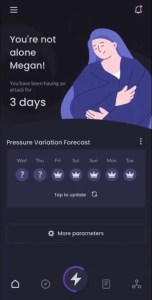
I use Migraine Buddy on my phone to track migraines and headaches, and you can use Medisafe to track when you have medicines.
Migraine Buddy: https://migrainebuddy.com
ORS I get from Ultima: https://amzn.to/3ZihOcZ
Medisafe: https://www.medisafe.com/download-medisafe-app/
It also helps to make notes of things so you can learn and begin to avoid getting a headache or a migraine as much as you can. I know it’s not completely avoidable. Sometimes you have to be around something that triggers a migraine, and sometimes they come on without warning; seemingly for no reason.

I do know to a certain extent headaches and migraines just come with having POTS and fluctuating blood pressure. Drinking water and staying hydrated helps with that, and having ORS helps you to stay hydrated.
I hope this helps!
Megan 🙂
If you liked this, you might like to check out My favorite health tracking apps for POTS.

 Megan Eileen